How to model the dynamic Life Cycle Inventory for forest management activities?
Forest ecosystem services include serval aspects like provision of wood, recreation, fresh water supply, soil protection and climate regulation (Sodhi & Ehrlich, 2010). There is an expected increase in the demand of the wood-based products...
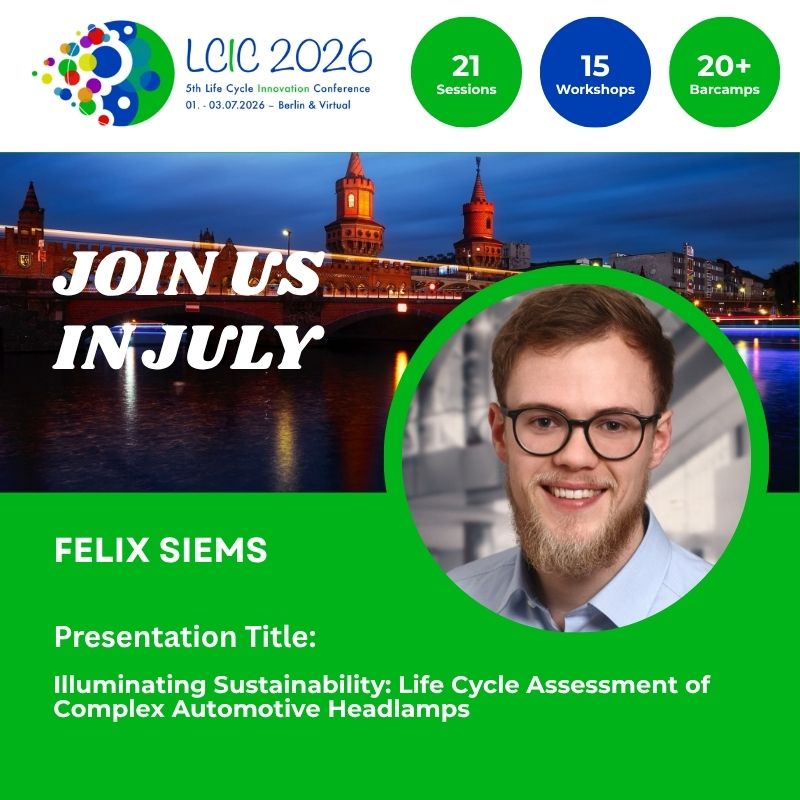
Illuminating Sustainability: Life Cycle Assessment of Complex Automotive Headlamps
This contribution presents results from “Nalyses”, a research project funded by the German Federal Ministry for Research, Technology and Space (BMFTR) within the MobilKreis programme that integrates Life Cycle Assessment (LCA) into the early development...

Industrial vs artisanal spirulina: Towards a healthier and more sustainable ‘superfoods’ sector
Session 08: Sustainable Innovation in the Food Sector (2)
Environmental degradation and food insecurity are two of the greatest challenges of our time, and its adverse effects undermine the world’s ability to achieve sustainable development. The strong interrelationship between these problems inflicts secondary damages...
Integrating safety and sustainability in chemical innovation: opportunities and implications of the revised SSbD Framework
1. Background Innovation and development are core characteristics of the chemicals sector. Materials and mixtures are essential for a wide range of applications, from functional textiles to advanced electronics and sustainable technologies. New chemical compositions...
Investigation into the Environmental Impact of Metal-Organic Framework Manufacture using LCA
With the acceptance from governing bodies that the future of decarbonisation requires CCUS as a key component [1,2], the need for carbon capture technologies that can remove CO2 from industrial emission sources in an energy...

LCA standards for environmental product assessments in the bioeconomy: A systematic review
Climate change mitigation is one of the European Bioeconomy Strategy (BES) priorities. In this regard, renewable raw materials are a crucial resource, as they help to substitute fossil resources and reduce greenhouse gas (GHG) emissions...
Life Cycle Assessment and Eco-Design for Energy-Efficient Automatic Industrial Machines
The transition to sustainable manufacturing requires the careful integration of environmental performance indicators into equipment design, particularly in the case of energy-intensive industrial systems. In this context, eco-design principles play a central role, guiding the...

Life cycle assessment of alternative Heating, ventilation and air-conditioning (HVAC) systems for egg production in Canada.
Industrial egg production is amongst the most rapidly expanding livestock sectors worldwide. Accordingly, ameliorating sustainability outcomes in the industrial egg sector is critical. Most non-renewable energy use in poultry house operations is consumed by heating,...
Life Cycle Assessment of Chemical Hydrogen Carriers. Assessing the impacts of dimethyl ether, methanol and ammonia
Within Germany's industrial sector—steel mills, chemical plants, and related facilities—hydrogen consumption reaches approximately 1.8 Mt per year, with nearly all currently produced from fossil sources. This hydrogen demand is projected to increase significantly in the...
Life Cycle Assessment of Circular Native Potato Starch Produced from an Industry Co-Product
Native starches, widely used in food industry, are carbohydrates traditionally extracted from agricultural raw materials such as wheat and maize. Beyond these conventional production routes, native starch can also be produced from reclaimed starch —...
Life Cycle Assessment of Composite Materials Recycling via Microwave-Assisted Solvolysis: A Laboratory-Scale Study
Fiber-reinforced polymer composites are widely used in high-performance industries, leading to increasing end-of-life waste and an urgent need for sustainable recycling strategies [1]. However, landfilling and incineration still dominate end-of-life management, despite significant environmental concerns...
Life Cycle Assessment of Fidesse ®️: A Circular Sugar Cane Product to Decarbonize Hybrid Food Systems
Cosun Beet Company (CBC) is a leader in sustainable sugar production. Sugar Beet Pulp (SBP) is a co-product resulting from sugar production, traditionally used to produce biogas or animal feed. Now, Cosun Ingredients will bring...

Get The Best LCIC Deal

Gold Sponsor

Silver Sponsor