Life cycle assessment of hydrogen produced through a liquid-phase photocatalytic process
Hydrogen can play a crucial role in the energy transition towards clean and renewable sources, and therefore in global climate change mitigation. However, nowadays only 4% of the worldwide hydrogen production comes from renewable sources...
Life Cycle Assessment On Calcium Zincate Production Methods: A Review
The main routes that have been studied in the synthesis of Calcium Zincate are: 1) Hydro-chemical route, 2) Hydro-thermal route and 3) Hydro-mechanical route. These conventional reactions present several drawbacks, being the Hydro-thermal route the...
Making Industrial Symbiosis Measurable: A Life Cycle Informed Multi-Criteria Framework
Industrial symbiosis (IS) is widely recognised as a key enabler of circular economy transitions, particularly within bio-based industrial hubs where material, energy, and by-product exchanges can significantly reduce environmental burdens and enhance resource efficiency. However,...
Measuring the Impact: Circular phosphate mining design strategies assessed based on LCA approach
In the pursuit of achieving energy transition and food security, phosphorus consists of a versatile element involved in several applications. Despite the fact that 80% of the phosphorus (P) is used in the agriculture sector,...

Measuring the sustainability of natural hazard resilient cities: developing a computational framework
Resilience to natural hazards in the built environment is essential to ensure sustainable cities. Climate change is expected to modify expected resilience needs and require adapting current and future buildings. Yet, measuring the environmental impacts...

Minimising rebound effects of lifetime extension: Sustainable business models for mobile, internet-enabled devices
Session 17: Innovative and Sustainable Business Models
The environmental impact of laptops, tablets and smartphones summarised as mobile internet-enabled devices (MIEDs) is highly relevant and increasing. The global market penetration of smartphones reached about 50 % in 2021 with 3.6 billion reported...
Mitsubishi Chemical Europe, our Story of using Life Cycle Assessment
Sustainability and its measurement are now crucial competitive advantages and business factors. The development of European environmental policy, for instance, the emergence of the Environmental Footprint (PEF/OEF) recommendation and the additional regulatory plans that can...

Moving away from the liquid: Sustainability implications of all-solid-state battery technology
Session 10: Life Cycle Innovation in the Transport and Mobility Sector (2)
Lithium-ion batteries (LIBs) have been the choice of battery technology employed in most electric vehicles (EVs) available today. However, recent studies have pointed out that the LIB technology slowly approaches its practical and theoretical specific...

Navigating Environmental Impacts through Life Cycle Analysis of Fossil Fuel and Bio-Renewable Sourced Polymers
In the pursuit of discovering a sustainable substitute for traditional plastics, bio-based plastics crafted from renewable raw materials have taken centre stage over the past two decades. Bio-based plastics are derived either partially or entirely...

Nickel slag recovery in New-Caledonia: Study of an innovative process with CO2 mineral carbonation using prospective life cycle assessment
New-Caledonia is one of the world’s largest suppliers of nickel. However, in producing nickel, the pyrometallurgical industries also produce million tons of nickel slag per year. Currently, only a small quantity is recovered as sand...

Organizational bottom-up LCA of a maximum-care university hospital in Germany
The healthcare sector is responsible for 4.4% of global greenhouse gas emissions. Hospitals face the challenge of sustainable transformation and must measure, monitor, and report on their sustainability performance. In contrast to top-down approaches, Life...
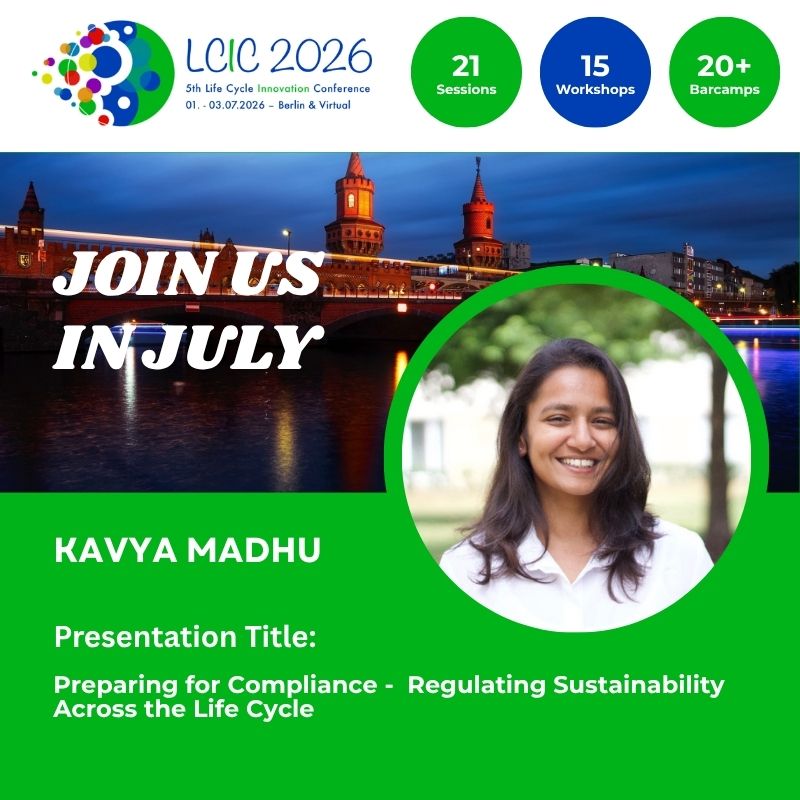
Preparing for Compliance – Regulating Sustainability Across the Life Cycle
Life Cycle Thinking is a core principle of product regulation in the European Union (EU). With the Ecodesign for Sustainable Products Regulation (ESPR) and Construction Products Regulation (CPR), the focus of EU regulation framework is...
Get The Best LCIC Deal

Gold Sponsor

Silver Sponsor