Enabling a circular economy for plastics: Life Cycle Assessment of Chemically Recycled Polyamide Multi-layer Packaging
Recycling technologies should aim to retain as much value in the material as possible, in line with the principles of the circular economy. Chemical recycling represents a technology with high potential to contribute to solving...
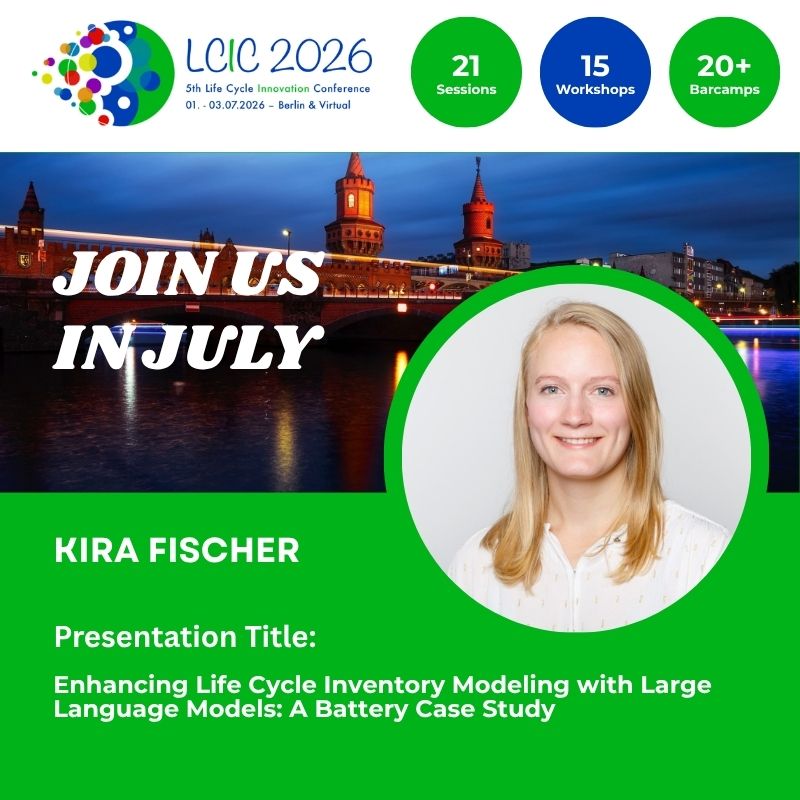
Enhancing Life Cycle Inventory Modeling with Large Language Models: A Battery Case Study
Life cycle assessment (LCA) is widely recognized as a key methodology for evaluating the environmental im-pacts of products and technologies across their entire life cycle. Against the background of the energy transi-tion, its application is...
Environmental Assessment Of Novel Biofuels For Marine Shipping
International shipping is one of the key contributors to climate changes due to the generated emissions to air (2% of global black carbon emissions and 3% of global greenhouse gas emissions) from marine fuels combustion....

Environmental Impacts Arising from the Production of Microbial Biosurfactants Rhamnolipid and Mannosylerythritol Lipid
Session 14: Life Cycle Innovation in the Bio-Economy
Increased use of assessment methods, classifying the environmental impacts of novel products, already in their development phase, reflects today’s growing interest in sustainable products. Especially bio-based development of widespread products like surfactants in the context...

Environmental sustainability assessment of a land based Icelandic food system- A case study from a planetary perspective.
Session 07: Sustainable Innovation in the Food Sector (1)
We share a unique relationship with the world through the food we consume; our diets are the closest relationship we have with the natural world and perhaps the most important one as it directly affects...

Evaluating sustainability: converting wood waste to energy and recycling for particleboard production
Disposing of waste wood represents not only a loss but also a missed opportunity to use valuable secondary resource. Wood waste, a renewable resource, can be efficiently repurposed for the particleboard manufacturing or as an...

Evaluating sustainability: Variations of LCA for chemical recycling
Undeniably, plastics have brought us enormous societal benefits owing to their versatility, lightweight, durability and low costs. However, production and recycling also bring challenges, e.g., only 10 % of plastic waste is recycled globally. To...

Expansion of the Land Suitability Rating System Model for Pulse Crops to Enable LCA of Alternative Agricultural Land Use Scenarios in Canada
Session 07: Sustainable Innovation in the Food Sector (1)
Food systems are responsible for significant anthropogenic terrestrial land use [1], nitrogen pollution [2] and greenhouse gas (GHG) emissions [3]. This leaves little room for expansion of the current methods and distribution of food production....
Fast, transparent, and ex ante: an LCA-based micro–meso tool for prioritizing environmental actions, demonstrated on a soil treatment company and an electronics company.
Industrial emissions remain at record highs, and operational decisions at company and industrial-park levels have immediate environmental consequences (IEA, 2025; World Bank, 2021). Yet, many life-cycle-based tools for circular economy (CE) planning are retrospective and...
Flexible laser-based manufacturing in the FLASH project: an environmental and economic approach through LCA and LCC
The FLASH project (Flexible Laser-based manufacturing through precision photon distribution) aims to shift the existing manufacturing paradigm (including cutting, drilling, welding, cladding and micro-machining, among others) by exploiting the benefits of multi-process laser systems and...
How modelling decisions shape conclusions in life cycle assessment: insights from a circular product system
The transition toward sustainable and circular construction solutions fosters the development and adoption of innovative products made from recycled and bio-based sources. As these products scale-up commercially, the role of Life Cycle Assessment (LCA) becomes...

How to link LCA and circularity assessments in the built environment? An exploratory study with two Belgian cases
Session 16: Applying Systems Thinking to guide the transition towards a regenerative Circular Economy (2)
The transition to a more circular economy is a political priority within the European Union. With its significant environmental impacts and long life spans, the built environment is a key sector to implement circular solutions....
Get The Best LCIC Deal

Gold Sponsor

Silver Sponsor